BBGA Conference Report: Celebrating 50 Years
/The annual conference of the British Business & General Aviation Association (BBGA) took place in London on Thursday, March 12, 2026. With war raging in the Middle East, there was a certain air of nervousness—many delegates had been busy coping with disruption.
BBGA Chair Aoife O’Sullivan opened the conference by reflecting on the “huge growth in their sector” since BBGA was formed 50 years ago, although then it was known as the General Aviation Manufacturers and Traders Association (GAMTA).
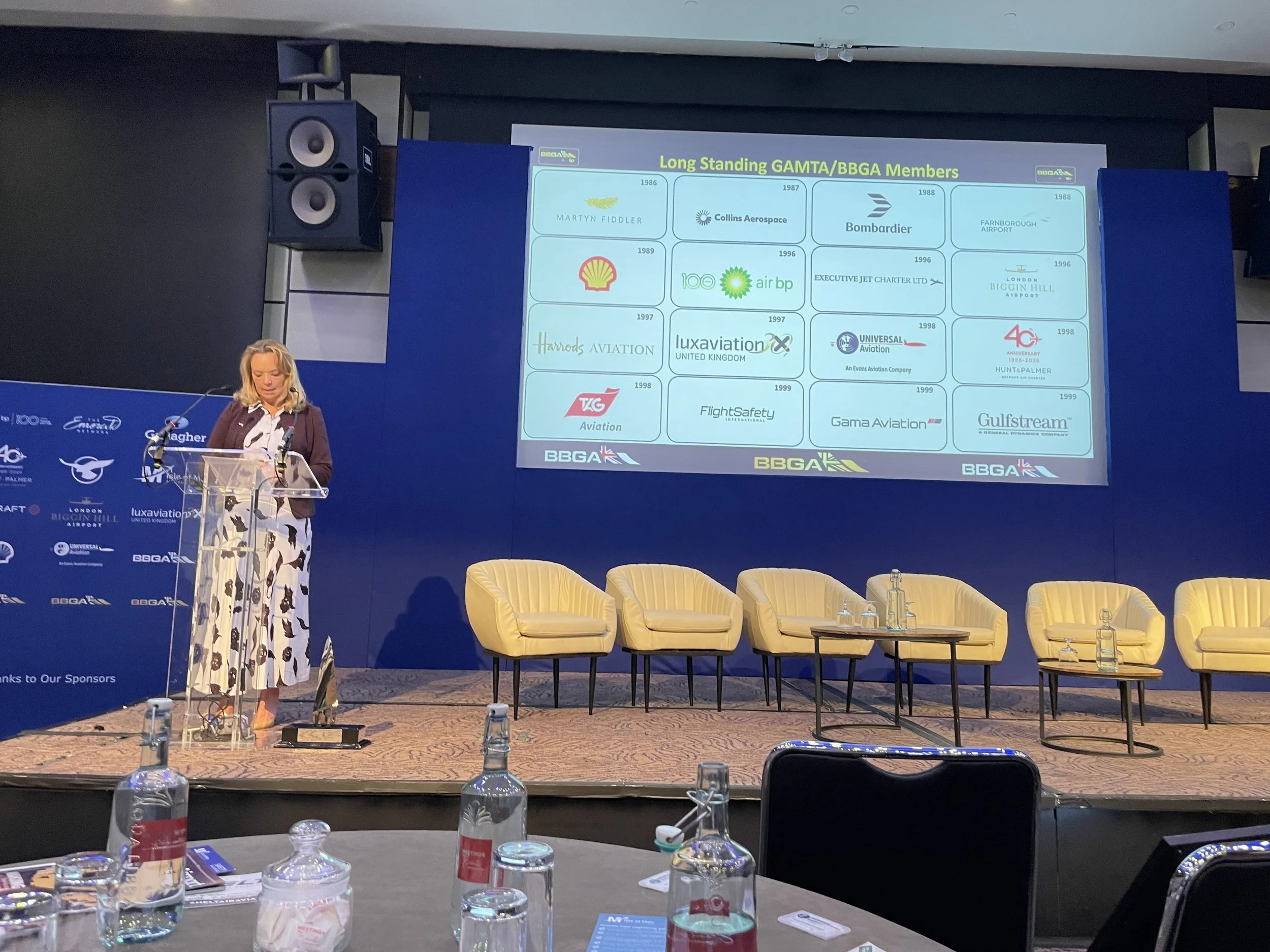
O’Sullivan also said, “Our thoughts are with our colleagues in the Middle East—the efforts of business aviation often go hand-in-hand [with such situations] and how the military and business aviation can work together when it matters most.” O’Sullivan also highlighted some other anniversaries this year, alongside BBGA’s 50th, including Hunt & Palmer turning 40, Air BP hitting 100, and NetJets celebrating 30.
Following the BBGA AGM, the association’s Managing Director Lindsey Oliver said work with IBAC (of which BBGA is a member association) and ICAO had been a highlight in 2025, centering on the ICAO General Assembly in Montreal last September. Areas discussed included GNSS, ADS-B flight tracking, IBAC’s IS-BAH standard for handling, SAF fuel scaling, and how to adopt a positive safety culture. “IBAC took to the floor 11 times during the Assembly—it was time well spent,” said Oliver.
Marc Bailey, BBGA CEO, outlined the various other organizations the association is working with as part of GA4Biz—created three years ago with ARPAS (the Association of Remotely Piloted Aircraft Systems), AOPA UK, and the British Helicopter Association (BHA) to provide a “single voice to government departments,” and UKASF—a similar grouping to interact with the UK CAA on airworthiness matters. BBGA also retains good relations with EASA through EASA’s Strategic Advisory Board, he noted.
Alex Durand, BBGA Vice Chair and CEO of Norwich-based SaxonAir, said the association had created a new working group on the “Future of Flight.” “This is an emerging opportunity and a threat in terms of us not adopting it fast enough—we have to be careful we don’t get left behind,” he said.
Numerous Challenges Being Addressed
Panelists discussed a range of topics from the status of the fleet worldwide (and in Europe) against the backdrop of the ongoing Middle East crisis; regional connectivity in the UK and how business aviation can play its part; heightened security concerns and how it’s essential to be prepared for the worst; the shortage of engineers and how the military is an underutilized source; and the success Shell has had creating an industry platform for Sustainable Aviation Fuel (SAF).
Delegates heard that it is currently a “seller’s market” for business aircraft and inventory is still relatively low, but deliveries of new aircraft increased 14% last year and are now coming up to 2019 (pre-COVID) levels. Business aviation continues to benefit from airlines having never come back to the levels of connectivity they provided before. Business aviation serves seven times as many city pairs in Europe as the airlines, and from the UK there were 2,265 connections to Europe in 2025 compared to 820 for the airlines.
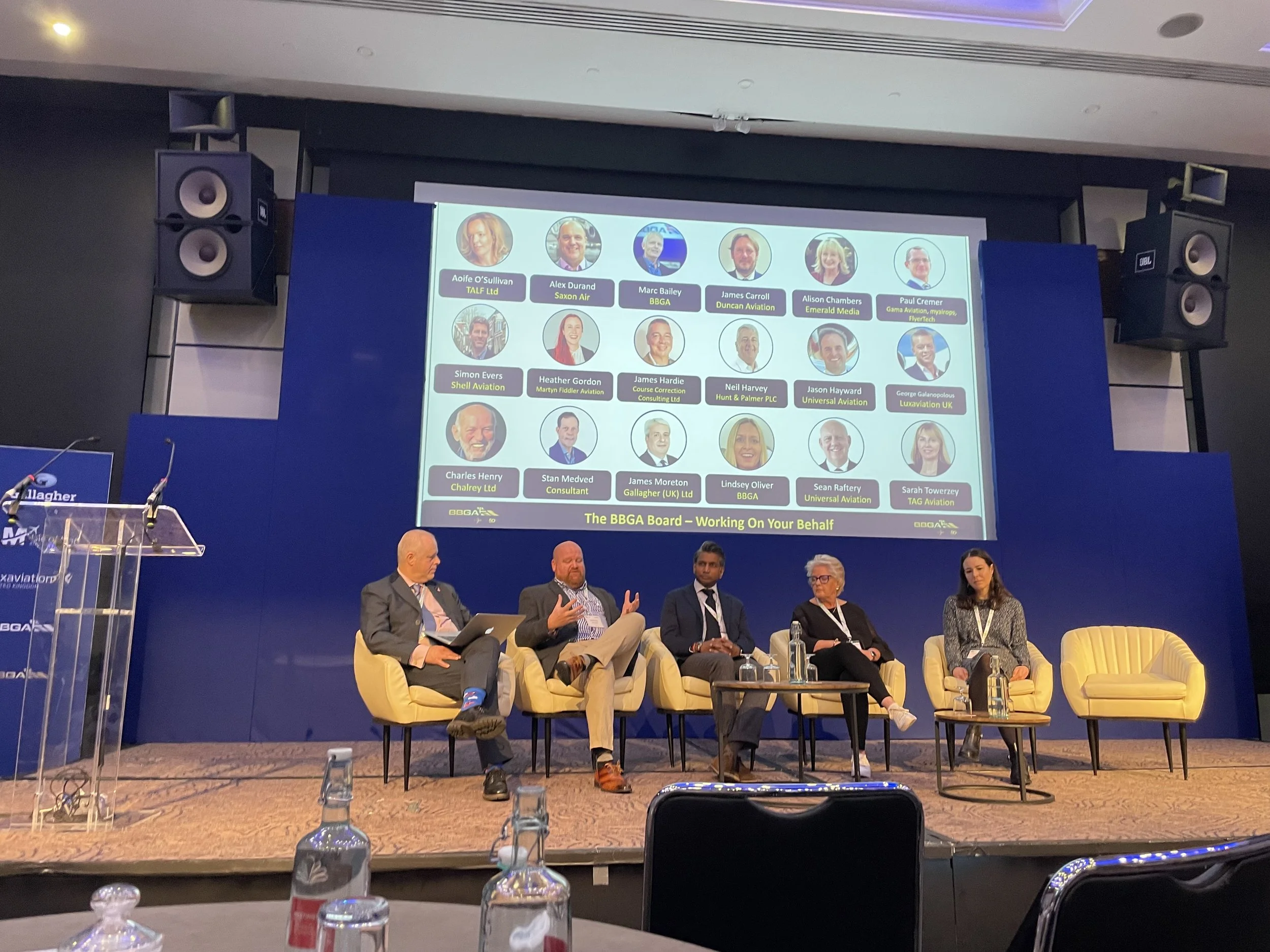
With funding for PSO (Public Service Obligation) routes looking vulnerable, UK airline Loganair was on hand to stress how much time, effort, and risk these represent given their inflexible conditions, and that, despite the funding, the route could still end up running at a loss. Meanwhile, the number of airlines in the UK has decreased from 44 to around 20 since 1991, so connectivity has really been eroded. “It’s very challenging to be a small airline,” said former Loganair CEO (now Managing Director of Isles of Scilly Skybus) Jonathan Hinkles.
On the issue of heightened security, Dynami CEO Eric Schouten reflected on the requirement for mental support as well as just evacuation when a situation (such as the current Middle East conflict) erupts. He also stressed that providing security doesn’t mean you’re going to “turn up in Humvees,” and noted that having been trying to sell travel intelligence services for some years, “now everyone’s calling.” Oliver Johnston of W4G Group advised, “It’s better to get things in place beforehand.”
CEO of the Royal Aeronautical Society, Dave Edwards, led a panel on aviation skills and said the most pressing challenge was the engineer shortage rather than the pilot shortage, describing it as an “existential challenge” and noting this is affecting General Aviation in particular. A new initiative has been developed to exploit engineers leaving the military, who often don’t go on to work as engineers in civil aviation and GA. To that end, the UK Ministry of Defense has developed a pathway with the British Army and CAA working together so that engineers can come into the civil world already qualified and prepared.
Shell Aviation discussed its approach to Sustainable Aviation Fuel (SAF), which the UK-based company now offers in some 80 locations in 18 countries (70 of the locations are in Europe and Africa, and Shell says it is “continuously trading SAF around the world”).
Shell has been very active in developing its “Book & Claim” system, Avelia, with around 66 airlines and 65 corporate customers now using it. Given its popularity, Shell has started to make Avelia “more independent,” although it is still owned by the company.
A panel session on fixed-wing air ambulance operations urged people to get proper insurance and heard that the best aircraft for such operations is the Learjet, but with these aging, there is a move to newer airframes, such as Embraer jets. It was noted that a proportion of the income from the BBGA conference would be going to the air ambulance charity, Lia’s Wings.
Rounding off the conference was Mark “Billy” Billingham, who spent 20 years in the British Special Air Service (the SAS) and, more recently, has become well known for the television program “SAS Who Dares Wins.” Before that, he provided security to “A-list” celebrities such as Brad Pitt and Angelina Jolie.
After an entertaining but also quite serious run-through of his career, Billy managed to convey to the audience how an elite unit such as the SAS is so effective, for example making sure they always have “the right people for the job” and then trust them; continuous pursuit of excellence; and a “Mission Success Cycle” of Brief-Plan-Deliver-Debrief so that everyone knows their role. He said every member is a leader; “Two is one and one is none”; and caring for the team comes before anything else. Last but not least, communication is the “lifeblood” of team cohesion.
Closing the BBGA Annual Conference, the association’s Chair Aoife O’Sullivan thanked everyone including the sponsors, panelists, speakers, and delegates. “We’ll continue doing our very best for you!”