Overflight Permits for India: Requirements and Application Process
/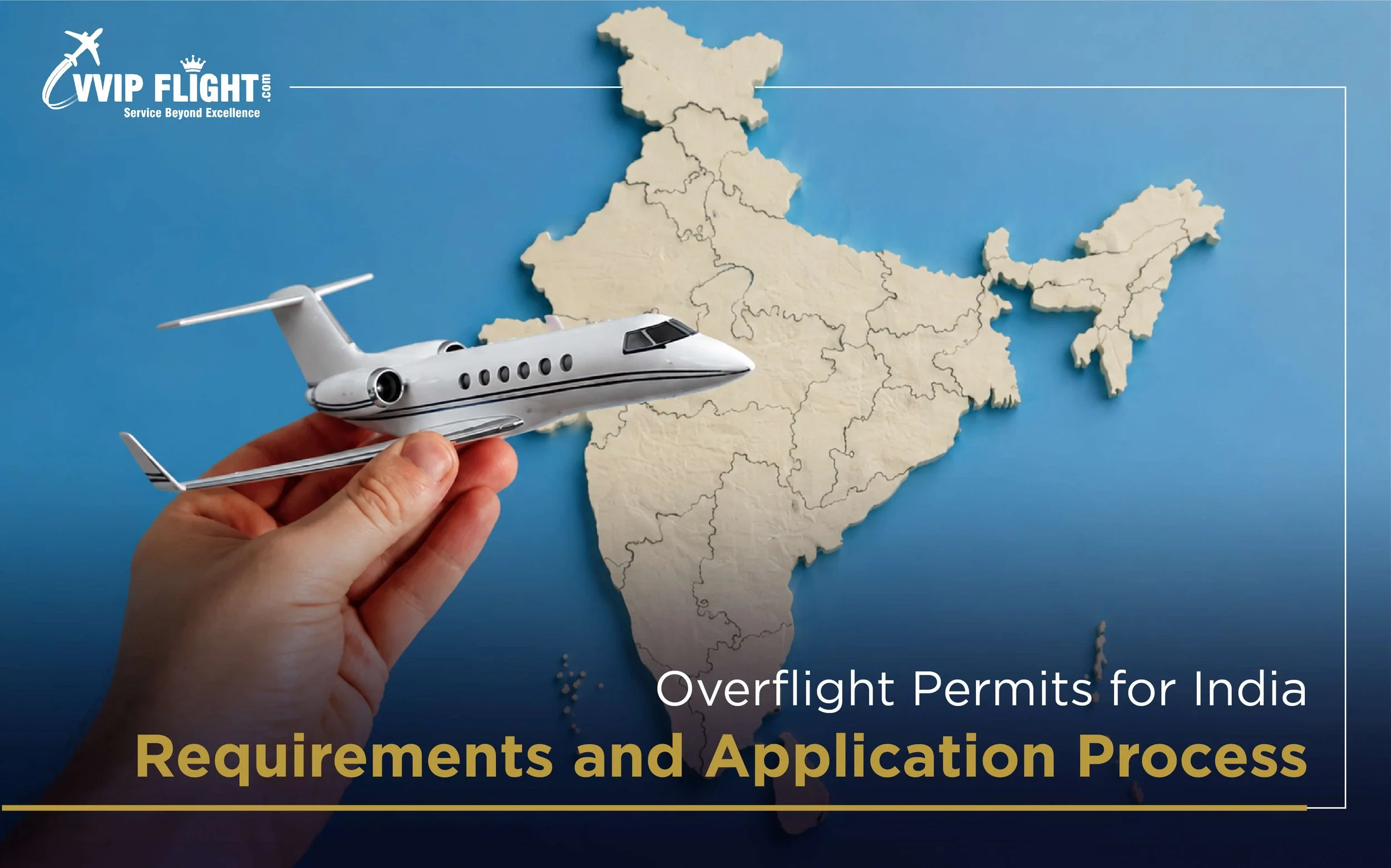
Any foreign-registered aircraft transiting Indian airspace without landing requires an overflight permit. This applies regardless of the aircraft type, the purpose of the flight, or the route being flown. There is no exemption based on prior permits, bilateral agreements between individual operators, or the frequency of the route.
Understanding exactly what an overflight permit covers, what it requires, and how long it takes is essential for any international operator whose routing crosses Indian airspace, whether the transit is a single crossing or a multi-leg route that passes through Indian airspace on multiple occasions.
What an Overflight Permit Covers
An overflight permit authorizes a specific foreign-registered aircraft to transit Indian airspace on a specific routing during a specific time window. It does not authorize the aircraft to land, take on fuel, or make any stop within India. If any of those elements are required, a separate landing permit or technical landing permit is needed.
The permit is tied to the exact routing submitted in the application. A change to the planned track, even a minor deviation caused by weather or ATC instruction, may require the routing details to be updated and, in some cases, the permit to be revised before the flight can continue.
Processing Time for Indian Overflight Permits
For most foreign-registered aircraft, an overflight permit is processed within 1 working day, meaning the flight can operate on the second day after the application is submitted. This is the standard timeline for aircraft originating from, or operating on behalf of, countries not subject to extended processing requirements.
For flights originating from China, North Korea, Pakistan, Afghanistan, Iraq, Somalia, or Nigeria, the processing time extends to 3 working days, with the flight operating on the fourth day after submission. This extended timeline applies uniformly regardless of the operator’s history or the specific routing of the flight.
Documentation Required for an Overflight Permit
An overflight permit application requires less documentation than a landing permit, but the information provided must still be complete and accurate. The standard requirements include full flight details covering the route, entry and exit points into Indian airspace, and the estimated time of crossing, crew details including the name and nationality of the Pilot in Command, and aircraft documents including the Certificate of Airworthiness and Certificate of Registration.
A General Declaration and passenger manifest are not required for a pure overflight since no landing is taking place, but crew details and aircraft documentation must still be accurate and current. An expired Certificate of Airworthiness or a crew list that does not match the actual pilot in command will cause the application to be returned.
Entry and Exit Points Into Indian Airspace
India’s airspace is divided into Flight Information Regions managed by the Airports Authority of India. For overflight operations, the entry and exit points into Indian airspace, along with the estimated time of crossing each significant waypoint, must be specified in the permit application. The routing should reflect the actual planned track rather than a generic estimate.
Once the aircraft enters Indian airspace, the ATC of the relevant Flight Information Region will provide an Air Defence Clearance number, which is the confirmation that the aircraft is cleared to proceed on its authorized routing. The pilot in command may be required to confirm this clearance before continuing.
Validity of an Overflight Permit
Like landing permits, overflight permits are time-bound. The authorization covers the specific time window stated in the application, and a flight that crosses Indian airspace significantly outside that window may not be covered by the existing permit. Operators managing multi-leg routes that cross Indian airspace on an outbound and return leg should confirm whether a single permit covers both crossings or whether separate applications are required for each direction.
Approach Plates for Military Airspace
Operators whose planned routing crosses airspace associated with Indian military or joint-use civilian and military airports should be aware that approach plates for these facilities are classified and are not published in the India Aeronautical Information Publication. This does not affect a pure overflight that does not interact with those facilities, but operators planning any contingency diversion into a military-use airfield should factor this into pre-flight planning.
Common Errors in Overflight Permit Applications
The most frequent errors in overflight permit applications are inaccurate entry and exit timing, a mismatch between the aircraft registration submitted and the aircraft actually operating the flight, and failure to account for the extended timeline that applies to restricted-origin countries. A second common error is assuming that an overflight permit obtained for a previous operation on the same route remains valid for a subsequent flight. Each operation requires its own application.
Overflight Permits for Neighboring Countries on the Same Route
Many routes that cross Indian airspace also cross the airspace of neighboring countries in the same sector. Nepal, Bangladesh, Sri Lanka, Bhutan, and the Maldives each have their own overflight permit requirements, processing timelines, and documentation standards. An overflight permit for India does not cover any portion of the route that falls within a neighboring country’s airspace.
Operators planning multi-country routes across South Asia should treat each country’s airspace authorization as a separate application process and ensure that all permits on the route are confirmed before departure, since a gap in one country’s coverage can disrupt the entire route even if all other permits are in order.
VVIP Flight manages overflight permit applications across India, Nepal, Bangladesh, Sri Lanka, Bhutan, and the Maldives, which means the full route can be coordinated through a single point of contact rather than through separate applications to each country’s civil aviation authority.
What Happens If an Overflight Aircraft Needs to Divert and Land
An overflight permit does not authorize a landing. If an aircraft operating on an overflight permit needs to divert into an Indian airport due to a medical emergency, technical issue, or weather requirement, the landing will be treated as an emergency entry rather than an authorized traffic stop.
Emergency landings are handled by ATC and airport authorities on a case-by-case basis and are not subject to the same pre-authorization requirements as scheduled landings. However, any subsequent departure from that airport once the emergency is resolved may require a separate landing permit to be obtained before the aircraft can legally depart as a non-scheduled traffic stop rather than an emergency arrival. Operators should clarify this with their ground handler at the diversion airport as soon as the aircraft is on the ground.
How VVIP Flight Manages Overflight Permit Applications
At VVIP Flight, we handle overflight permit applications for operators transiting Indian airspace as part of a broader trip support framework. This includes confirming the correct routing details, verifying documentation before submission, and liaising directly with the relevant authorities through to approval. For operators on routes that cross Indian airspace regularly, we can coordinate permit applications alongside other pre-flight requirements to ensure the full operation runs on a single managed timeline.
For assistance with overflight permits for India or any other permit requirement across South Asia, please contact our operations team at ops@vvipflight.com.
Disclaimer: Kindly note that the information provided in the above article is subject to change without prior notice. We recommend contacting our operations team for the latest regulations, updates, and accurate information before planning your trip.
Frequently Asked Questions (FAQs)
Does every foreign aircraft transiting Indian airspace need an overflight permit?
Yes. All foreign-registered aircraft transiting Indian airspace without landing require an overflight permit, regardless of aircraft type, purpose, or routing.
How long does an Indian overflight permit take to process?
Standard overflight permits are processed within 1 working day. For flights originating from restricted countries including China, North Korea, Pakistan, Afghanistan, Iraq, Somalia, and Nigeria, the processing time extends to 3 working days.
What documents are needed for an India overflight permit?
Applications require full flight and routing details, crew details including the Pilot in Command’s name and nationality, and current aircraft documents including the Certificate of Airworthiness and Certificate of Registration.
Does an overflight permit cover both outbound and return crossings of Indian airspace?
Not necessarily. Operators should confirm whether a single permit covers multiple crossings of Indian airspace on the same routing or whether separate applications are required for each direction.
What is the Air Defence Clearance number in the context of an overflight?
The ADC number is issued by the ATC of the relevant Flight Information Region once the aircraft enters Indian airspace, confirming the aircraft is cleared to proceed on its authorized routing.